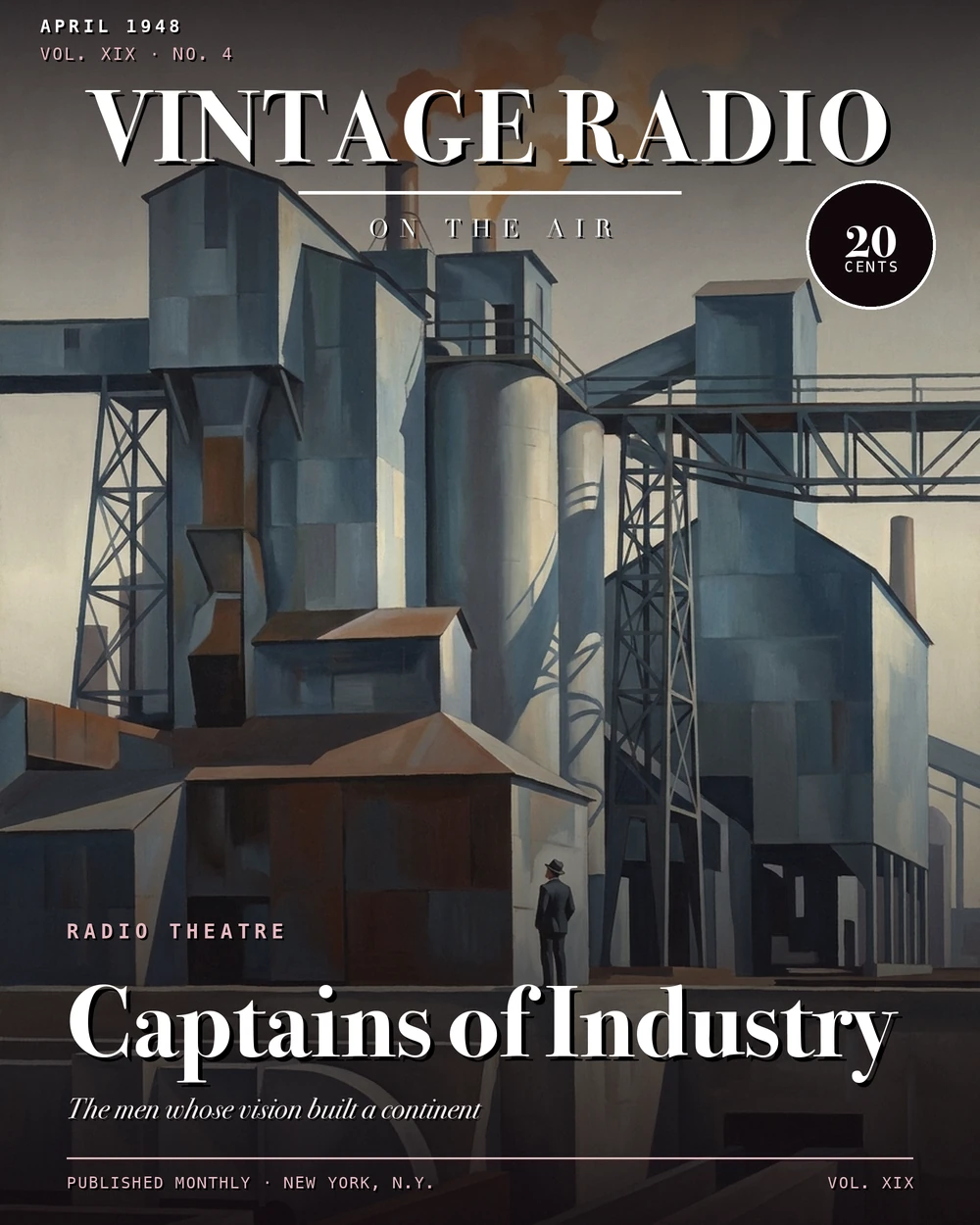
Captains of Industry
The Idea Behind the Series
Captains of Industry came out of a particular moment. Recorded in the early 1930s and syndicated for broadcast by 1937, the series was designed as an antidote to the Great Depression — an inspirational run of biographical dramatizations meant to remind North American audiences what drive, ingenuity, and persistence could accomplish. The producers at ARC Productions, the Canadian company also known as Atlas Radio Corporation, envisioned each episode as a compact portrait of someone who had built something lasting: a corporation, an industry, a philanthropic institution, or sometimes all three.
The format was practical and consistent. Each of the 52 episodes ran 15 minutes and focused on a single figure, blending dramatized scenes with narrative storytelling to move through a life quickly. There was no recurring host identified in the surviving record, no ongoing plot — just one industrialist per week, their story compressed into a quarter hour. The total run across all episodes comes to just over ten hours of programming, a tidy self-contained archive of early commercial radio biography.
Atlas Radio Corporation had been founded in 1921 by David Louis Harris, a Jewish immigrant who built one of the pioneering radio, television, and electronics manufacturing operations in Canada and the United States. The Canadian origin matters: the show profiled figures from both the United States and Canada, making it a North American historical series rather than a strictly American one, even though most of its subjects had made their names south of the border.
Who the Show Profiled
The first episode set the tone immediately by opening with Andrew Carnegie, the railroad and steel industrialist who gave away most of his fortune before he died. Starting with Carnegie was not an accident — he embodied exactly what the series wanted to argue: that great wealth and great generosity could come from the same source. From there, the show ranged widely across industries and eras.
The roster covered an impressive spread of the late 19th and early 20th century business world. Steel and railroads appeared through Carnegie, Henry Clay Frick, Cornelius Vanderbilt, Leland Stanford, and Edward Henry Harriman. Publishing showed up in the form of Joseph Pulitzer and Frank A. Munsey. Finance and banking were represented by J. Pierpont Morgan, John Jacob Astor, and James Couzens, the U.S. Senator who had earlier made his name in banking and the automotive industries. Retail came in through Frank W. Woolworth and Marshall Field. Entertainment had Phineas T. Barnum. Petroleum had Edward J. Doheny. Meatpacking had Philip Danforth Armour.
Other episodes covered figures whose industries were harder to categorize in a single word. George Eastman built a photography empire. King Camp Gillette turned disposable razor blades into a global business. Charles Lewis Tiffany defined American luxury jewelry. George Westinghouse pioneered electrical systems. John Hays Hammond Jr. was an inventor tied to radio technology. Thomas Edison rounded out the roster in an episode that must have felt, to any listener in the 1930s, like profiling someone they had grown up alongside. The final episode in the run, number 52, covered William Andrews Clark, the Montana copper magnate and senator.
What the Show Actually Did With Its Subjects
The series did not simply celebrate its subjects. Triumph, innovation, and ethical dilemma all appeared as recurring themes, and the roster itself made it impossible to avoid the complications. Henry Clay Frick was one of the central figures in the Homestead Strike, one of the bloodiest labor confrontations in American history. Edward J. Doheny was at the center of the Teapot Dome scandal. Elias J. Baldwin built his fortune in California real estate and mining amid persistent controversy. Mark Hanna was a political operator as much as a businessman.
The 15-minute format inevitably meant compression, but the fact that the series tackled these figures at all — rather than staying safely with the unambiguous success stories — suggests the producers understood that their audience would find something hollow in pure hagiography. Presenting both successes and failures of its subjects was part of the stated design. The show drew comparisons to other dramatized historical narrative programs of the era, including Men Who Made America and You Are There, which placed it in a specific radio tradition: the educational entertainment format that tried to make history feel immediate by putting it in dramatic form.
How It Fits in the Radio Landscape
By the time Captains of Industry was in syndication, the 15-minute episodic format was already well established in American radio. Daytime serials ran in exactly this slot; so did news programs, musical quarter hours, and instructional shows. What the series was doing — taking that compact format and applying it to biography — was a sensible match of length to subject. A life doesn't need to be exhaustive to be illuminating. Fifteen minutes was long enough to sketch the key facts and hit the emotional beats, short enough to hold attention.
The series covered an unusually broad industrial spectrum for a single show: petroleum, meatpacking, publishing, jewelry, telecommunications, sugar, confections, chemicals, lumber, banking, finance, and entertainment all appeared across the run. That breadth was partly a function of having 52 episodes to fill, but it also reflected the genuine diversity of the Gilded Age economy that most of these figures had helped create. By moving from railroads to candy to newspapers to razor blades, the show was implicitly making an argument about the variety of ways ambition and ingenuity could express itself.
All 52 episodes survive as recordings, which is a notably complete run for a syndicated series from this period. Radio collector J. David Goldin documented plot summaries for each episode at the RadioGoldIndex, providing a detailed reference that researchers have drawn on since.
Why It Still Holds Interest
Listened to now, Captains of Industry functions as a period document on two levels simultaneously. On one level, it's a record of how the 1930s understood the generation that had industrialized the continent — what it chose to emphasize, what it chose to minimize, and which figures it considered worth fifteen minutes of a family's evening. On another level, it's a snapshot of how radio used dramatization as a teaching tool before television arrived and changed the calculus entirely.
The subjects themselves remain figures of genuine historical weight. John D. Rockefeller, Carnegie, Morgan, Vanderbilt — these are names that still anchor discussions of American economic history. But the series also made room for figures less remembered today: Frank Munsey, the newspaper consolidator who was widely despised by journalists of his era; George Westinghouse, who tends to be overshadowed by Edison in popular memory despite comparable importance; Cyrus McCormick, whose reaper transformed American agriculture. The mix gives the series a texture that a show built only on household names would have lacked.
The North American scope, however modest its expression, also distinguishes the series from its American contemporaries. A Canadian production company taking on the story of the industrial age — and including Canadian figures alongside the American titans — gives Captains of Industry a perspective that sets it slightly apart from the U.S.-produced historical dramatizations it otherwise resembled.